
2026.06.22
(This piece is also published in Creation Care and The Bible Substack, 2026.06.21)
Having been invited to preach and teach about creation care in numerous churches over all these years, I observed, sadly, that the “conventional ways,” such as referencing stewardship and the creation mandate in Genesis 1, while still getting some polite nods, have become increasingly difficult to move the needle toward meaningful responses, let alone tangible actions. At times though, I found that by connecting the care of God’s creation with the “Great Commission” of Christ, the message would receive some surprising attention. The following is an example of such attempts of mine in recent years, through an exposition of the Gospel of John.
Let’s start by discerning the larger picture of the Gospel. Here we encounter a chiastic structure typical of the Scripture, though in a much larger scale, covering the entire Gospel (Hamilton 2025, 28), as shown in the following:
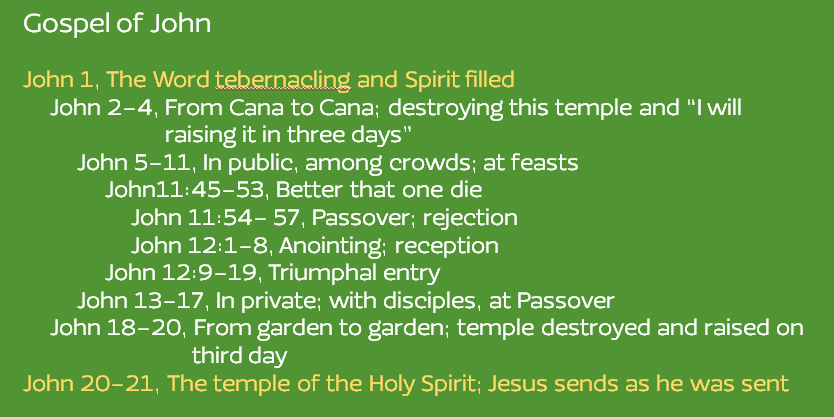
Now our focuses are on the first and last sections, which are corresponding to each other.
At the very beginning of that Gospel:
“In the beginning was the Word, and the Word was with God, and the Word was God. He was with God in the beginning. Through him all things were made; without him nothing was made that has been made. … The Word became flesh and made his dwelling among us. We have seen his glory, the glory of the one and only Son, who came from the Father, full of grace and truth,“ (John 1:1-3, 14, NIV)
The first sentences bring us not only back to the narrative of Genesis 1, the beginning of everything, and to the God who created the whole cosmos but also point the Christ depicted in the Christological poem of Colossians 1:15-20 – the Christ, in whom, through whom and for whom all things were made. He is the one holding all things together, and he is the one reconciling all things to God.
How then Christ the Creator and Sustainer reconciles all things? While the cross is the way in both Colossians and the Gospel, John the Evangelist emphasizes that the reconciliation begins with the Incarnation. Christ was sent to the world, incarnated into the all things he created and is sustaining. In verse 14, John essentially proclaims that the Sovereign Lord God had returned as promised in the Old Testament, pitching His tent among His people (“dwell among” is literally “tabenacling”). And in His incarnation Christ shows forth everywhere God’s glory, which actually means God’s all-encompassing presence, full of grace and truth. The glorious presence of the Lord God was manifested in the person of Jesus throughout the Gospel, reconciling, making things and relations right, again and again – turning water into wine for a banquet, feeding the hungry, healing the sick, restoring the outcast, liberating the possessed, even raising the dead. The visions of Shalom were invoked in all these Christ’s actions.
Here the “Word becoming flesh” and “tabenacling” resonates deeply with yet another Christological poem, Philippians 2:5-11, which continues the same affirmation of Christ’s divine identity and works, but now brings the Incarnation of Christ to the forefront. Christ, “being in very nature God, did not consider equality with God … [for] his own advantage; rather, he made himself nothing by taking the very nature of a servant, being made in human likeness.” (v.6-7, NIV). In the Incarnation, God the Son empties himself and takes on the form of a servant and becomes human, not by relinquishing his divine nature, but by voluntarily setting aside the divine privileges to live as a simple and limited human being, dying on the cross, and demonstrating ultimate humility.
Now, let’s leap forward to the corresponding final unit of John’s Gospel. Here we read that this same Word Incarnate, now the resurrected Lord Jesus, appeared in front of his fearful but anticipating disciples, and told them:
“Shalom be with you! As the Father has sent me, so I am sending you.” And with that he breathed on them and said, “Receive the Holy Spirit. If you forgive anyone’s sins, their sins are forgiven; if you do not forgive them, they are not forgiven.” (John 20:21-23, NIV)
With the echo of John 1:14 looming large, we hear that Jesus was essentially saying: “I am sending you all now in the similar fashion as God the Father has sent me.” Jesus the Word was sent to dwell among humanity and in the world, “pitching his tent in our neighbourhoods.” (The Message) And that is the glorious presence of the Son in the world, full of grace and truth.
Now Jesus commissioned his followers, essentially and subsequently meaning all Christians, to be His faithful presence in the world with grace and truth, in the similar way as God sent His only beloved Son pitching the tent among His people once again. And they were “installed” into this commission by Jesus’ act of “breathing on” them. This invokes yet another powerful echo, this time from Genesis 2 – the Lord God installing His priestly representative in His cosmic Temple – now not just one adam but many of his descendants (Provan 2006 / 2008; Walton 2006, 114-5; Middleton 2014, 48).
According to John, this Incarnation-oriented commission of Christ’s disciples has the “forgiving of sin” as the main given task. In the biblical traditions, this is in fact the shorthand of the roles and functions of royal priests, whose main task is not primarily about passing verdicts or condemnations, but instead, making and declaring relationships in the right, as N.T. Wright makes clear (Wright 2026, at the 15th minute, also Wright 2016, 77-80, 99, 159, 290, etc.).
This is corresponding to Christ’s ultimate work – reconciling all things to Himself, as narrated in the Colossians poem we referred to earlier. Now that the disciples were commissioned to participate in that work of Christ, by being the faithful presence, essentially the witness-in-action, of Christ’s work of making all things right in various relationships, including humanity with God, within humanity, and humanity with the rest of the creation. This threefold reconciliation in fact leads toward the biblical vision of Sabbath-Shalom (Brueggemann 1978; Yoder 1997; Timmer 2017).
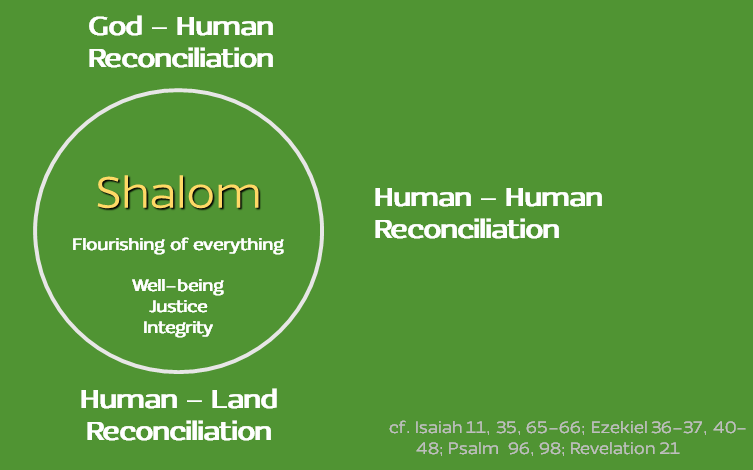
Furthermore, both the sending of Jesus by the Father and the sending of the disciples by Jesus involve the Holy Spirit, who is present all through God’s works in creation: right at the very beginning of the cosmos, in the forming of the first humans as imago Dei, in the Word becoming flesh, in the commissioning of the renewed and transformed imago Dei in Christ, and in the continuous empowering presence among God’s people in the world. This completes the magnificent picture of Missio Trinitas, that is, the triune God – Father, Son, and Holy Spirit, working in tandem to create, sustain, redeem, and renew not just humanity but all of creation, in which the redeemed humanity is also involved and commissioned to play a pivotal part (Park 2025).
This Incarnation-oriented and Trinitarian commission of Christ’s disciples into the world has profound implications in Christian mission. Christ commissions all of us, his disciples, to participate in His reconciliation of all things, full of grace and truth, or in other word, being a faithful presence and witness-in-action of Him who is already on the move making all things right. This obviously and certainly includes caring for God’s creation in all aspects of our lives and works. Meanwhile, the divine self-emptying, relinquishing privileges, identifying with the others, humble servant-hood, even to the “extreme” of sacrificing himself, provide us with the crucial theological and practical pointers to the key postures and approaches of how Christian mission in the world should look like. And this is certainly, and rightly, applicable to the creation care mission as well.
Reference:
Brueggemann, Walter. 1978. Living Toward A Vision: Biblical Reflections on Shalom. United Church of Christ Press.
Hamilton, James H. Jr. 2025. In the Beginning Was The Word: Finding Meaning in the Literary Structure of the Gospel of John. Grand Rapids: BakerBooks.
Middleton, J. Richard. 2014. A New Heaven and a New Earth: Reclaiming Biblical Eschatology. Grand Rapids: Baker Academic.
Park, Bokyoung. 2025. “Resonance as Mission: Reimagining Missio Trinitas in the Era of World Christianity.” 2025 Missiology Lectures. Fuller Seminary. October 15, 2025. https://fullerstudio.fuller.edu/video/resonance-as-mission/
Provan, Iain. 2006. The Book of Genesis. Regent College Lecture Recording. Regent Audio, 2006 – http://www.regentaudio.com/RGDL3603S?category_id=32.
Timmer, Kevin J. 2017. Shalom Seeking: Foundations of Flourishing. Cedarville University.
Walton, John H. 2006. Ancient Near Eastern Thought and the Old Testament: Introducing the Conceptual World of the Hebrew Bible. Grand Rapids: Baker Academic.
Wright, N.T. 2016. The Day the Revolution Began: Reconsidering the Meaning of Jesus’ Crucifixion. San Francisco: HarperOne.
—. 2026 “God’s Homecoming: The Biblical Story We Were Never Taught.” The Center for Bible Study, February 25 2026. https://youtu.be/AnLQLpy2MOA?si=sO8gUub0ji8FduVB.
Yoder, Perry B. 1997. Shalom: The Bible’s Word for Salvation, Justice, & Peace. Institute of Mennonite Studies.

