
The Missional Presence of the Transformed imago Dei in midst of the Contemporary Ecological Crises
2026.04.10
A paper presented at the Evangelical Missiological Society EMS Canada 2026 Regional Conference (BC)
Author Note: In this paper, while I will interact with a few of the important academic research on the subject in concern, I approach this topic primarily from a practitioner’s perspective, with a pastoral lens. I might sound like delivering a sermon instead of presenting an academic paper.
In the Beginning…
“God created mankind in his own image, in the image of God he created them…” (Genesis 1:27, NIV)
In response to the call for Christian faith-based concerns and actions for the environment, also known as creation care, the paradigm of “stewardship” has been the dominant theological discourse among Christians across the confessional spectrum. Advocates of Christian environmental stewardship usually locate its theological basis in the text of Genesis 1:26-28 in the Creation narrative, with the emphasis on humankind being created in the image of God, or imago Dei. This is particularly the key for those on the conservative side of the global Christian communities.
Let’s examine the connection between the two.
The biblical reference of the imago Dei and its connotations indeed constitute the Christian theological foundation of human identity and existence. Throughout history, there have been numerous attempts trying to make sense of that reference in the Genesis account. These diverse readings include the human possession of reason, free will, or moral capability similar to that’s of God, or the spiritual capability to communicate with God. While these readings might make sense from angles suiting our contemporary sensitivity, all of them were in fact foreign to the first audience of the narratives. In the last few decades, there has been a more convincing reading which is sensitive to the historical, cultural, and political context of the text when it was finalized, and that of the ancient Near Eastern peoples, who were among the first ones to listen to this narrative (Blocher 1984; Hall 1985; Middleton 2005 & 2014; Walton 2006 & 2009).
This reading situates the imago Dei in the integral narrative unit of Genesis 1:1 to 2:3. For the ancient Near Eastern audience, that narrative depicts that the whole cosmos, which comes into being by the verbal commands of the Creator God, is essentially His cosmic temple-palace (Walton 2009, chap.8; Beale 2004, chap. 2).
The Creator God, by His mighty Word and through His Spirit, brings order to chaos, shapes the forms of the created order, fills the heavens and the earth with splendour, beauty and nurturing diversity (Genesis 1:1-2:3; also ref. Job 38-41). Then God sees and thus declares all these He has made as “good,” and climaxes the creation acts with the Sabbath. The whole of creation is His temple-palace, in proper order and fully functional. In that final scene of God taking rest, it is not about God in need of rest after creating the cosmos, but is essentially about the Sovereign Lord God now being seated in His cosmic throne room, fully in charge and at peace with appreciation, pleasure, and joy (Beale 2004, 62-63; Walton 2009, chap. 7). The heavens and the earth are God’s work, thus totally belong to no one else but God alone, as the psalmist proclaims, “The earth is the Lord’s, and the fullness thereof” (Psalm 24:1a, KJV). This emphasis signifies God’s sovereignty over all things that are made, alive and inanimate, seen and unseen. It is within this theocentric and kingly positioning that we would understand the profound meanings of humankind being created in the imago Dei.
Simply put, the imago Dei here in its proper context refers to the tangible reflection or royal representation of the Sovereign Lord God in His own land. To illustrate this with a contemporary example: In many public squares and places in front of the legislative buildings across Canada we see bronze statues of the British monarchs of the 19th century and early 20th century. At the time these statues were erected they were not merely decorative or commemorative; they represented the British monarchs as the heads of state of this realm, signifying his or her reign and sovereign presence in this land. While this symbolism is no longer completely valid in our time, the erection of a monarch’s statues or image to represent their sovereign presence was a consistent practice in ancient Near Eastern regions such as Egypt, Mesopotamia, Persia, and later the Roman Empire. These are precisely the “images” that the ancient audience would understand their meanings and significance. In fact, the word “image” is also used multiple times in the Old Testament to describe “idols.”
Now, it is important to emphasize that the imago Dei is immediately tied to the divine mandate and functions for the humans to “fill the earth, subdue it, and rule over” in Genesis 1:28. Therefore, theologically speaking, this reading entails a functional interpretation: “the Image as the Mediation of Power” (Middleton 2005, 28). Richard Middleton explains concisely, “on this reading, the Imago Dei designates the royal office or calling of human beings as God’s representatives and agents in the world, granted authorized power to share in God’s rule or administration of the earth’s resources and creatures” (Middleton 2005, 27).
Of course, this exercise or mediation of sovereign power, if reading the whole of biblical accounts carefully and faithful to their original intents, should not entail human abusive behaviours and exploitation of the earth, as many have criticized so in recent history exemplified in the famous thesis by historian Lynn White Jr. (White 1967, 1203-1207). Humankind, being the imago Dei, is supposed to fulfil this given role and exercise the sovereign power of God by modeling after the ways God the Creator would see and rule His realm, the whole of creation. There are numerous biblical references and passages describing how God rules the heavens and the earth He creates. Psalm 145 is one among them. In this psalm about praising the Lord God as King, God’s kingship and ruling over the earth are characterized by wisdom, power, goodness, kindness, mercy, abundance, generosity, provision, protection, justice, and love. Since God possesses these qualities and dispositions in and for all creation, it is our calling and duty, as His mandated and entrusted representatives, to reflect these qualities of God, “ruling” on His behalf accordingly. It is absolutely certain that “rule over” or “have dominion” are not the “license” to condone arbitrary and reckless behaviors!
Meanwhile, the picture of humankind as the imago Dei is also found in the second chapter of Genesis, though without the word “image,” yet equally profound. In the narrative segment of Genesis 2:7-15, another very powerful imagery is employed, which is shocking to both the ancient audience and the contemporary readers alike.
Again, the narrating context is crucial here. Many biblical scholars have already pointed out that the description of the Garden of Eden in Genesis 2:8-14 – located in the east, surrounded by four rivers and filled with gold, pearls, and jewels – is loaded with imageries of a temple, which would be familiar to the inhabitants of the ancient Near East (Walton 2006, 123-127, 196-199). And then the shocking part lies in Genesis 2:7, where the narrator told us that “The Lord formed the adam [man] from the dust of the adamah [ground], and breathed into his nostrils the breath of life, and the adam [man] became a living being.” Both “adam from the adamah” and “living being” – in the latter case the same phrase is employed to describe the creatures in the sky and seas and on the land in Genesis 1, remind the hearers, then and now, playfully yet categorically that we humans are no different than the other creatures in essence. Meanwhile, this is also a picture that would be very familiar to the ancient hearers. In the religious customs of the neighboring nations of the Hebrew people, priests would often place newly completed idols in their temples and then symbolically blow a breath into the idol’s nostrils or perform some kind of cleansing ritual on the idol’s mouth. This symbolized that the idol, made of clay, wood, stone, or metal, had been “animated” and “coming alive,” ceremonially and officially becoming a representative of the deity they worshipped (Provan 2006 / 2008; Walton 2006, 114-5; Middleton 2014, 48). Although the word “image” is not used here, we are given a profound imagery that God himself installed the adam [man] as the “image” representing Him in this cosmic temple that He created. (We will come back to this reference later for an important aspect of this thesis.)
The temple scene is further reinforced in Genesis 2:15, where it reads, “The Lord God took the man and put him in the Garden of Eden to work it and take care of it.” Both words “work” (abad) and “take care” (shamar) correspond to the priestly functions in the Tabernacle and the Temple in the later biblical accounts, such as Numbers 3:7-8. That means the Lord God installs His “image” in His Temple, not only to represent Him but also to act in the priestly roles. Here again is an interesting echo to the earlier reference of the imago Dei in Genesis 1:28, though this time with some not-so-subtle differences and more on the shared nature of humankind with the other creatures. Based on both Genesis accounts, the imago Dei carries a combined royal and priestly function in God’s creation, or in N.T. Wright’s phrase, the “angled mirrors” (Wright 2016, 100).
The Creation narratives, found in Genesis as well as in Psalms, the Book of Job, and other prophetic writings, lead us to see not only where we are as humans but also who we are in this created world. The Scripture asserts that we are creatures, as all other creatures in the cosmos. We owe our lives and existence to God; we are not overlords but creatures, no matter how noble and unique we might be (Hebrew 2:6-8). Meanwhile, we are indeed special amongst creatures, for we are created to be the image of God and are blessed to fulfill that image.
It is from these accounts in Genesis that the paradigm of “stewardship,” as it is commonly understood and advocated, might find its most obvious biblical ground. However, it is necessary to point out that this grounding is satisfactory only to a limited extent. For one, even though the concept of “steward” might resonate with the role of representative in some degrees, such concept is not evident, obvious, nor literally referenced elsewhere in the Bible as it relates to the calling or duty of humankind. More importantly, as explained above in details, the meanings of the imago Dei as the divine royal representative are far more profound and complex than that of merely stewardship. In order to substantiate an important doctrinal paradigm such as this, we would require broader sets of biblical evidence and theological deliberations.
Beyond Stewardship
Before I present the main arguments towards the theme of this paper, “Far More Than Stewardship,” I would like to note here that I’m not entirely dismissive of the connotation or terminology of “stewardship.” Practically, it still has its merits.
It is absolutely appropriate to insist that we humans still need to be better stewards of the earth, individually and collectively. To conserve, protect, and wisely manage all creatures as mandated by God is still essential. Meanwhile, the term is still useful. When communicating with fellow Christians, who are not entirely onboard with the topics of environmental concerns, because of cultural contexts, theological convictions, or even the polarized political circumstances of our time, “stewardship” remains as an effective and widely appreciated way to nurture common ground and understanding (Groenendyk 2019, chap. 2). From my own experiences in creation care ministry, I can also attest that the language of “stewardship” is conductive in the inter-faith dialogues and collaborations with other faith traditions and diverse sectors of the society on the environmental fronts. After all, “stewardship” is not a uniquely Christian concept, since other religious traditions and the secular environmental movements also employ this concept as part of their rationales.
Nevertheless, I would argue that the paradigm of “stewardship” alone is far from sufficient, theologically, practically, and missionally speaking, for Christians to address the threefold ecological crisis – pollution, biodiversity loss and climate change, which we find ourselves in at this historical and ecological juncture of the 21st century and likely beyond.
First of all, I concur with the critical assessments of this paradigm in recent years, most noticeably, by Professor Richard Bauckham in his Bible and Ecology: Rediscovering the Community of Creation (2010), and the scholars and practitioners expressing their reflections and thoughts on this subject in Beyond Stewardship: New Approaches to Creation Care (2019). Due to the limited space and scope of this paper, I would offer only a few summarizing observations of these assessments.
Bauckham is among the first suggesting that Christians need a paradigm shift on the care of the created world, starting with a re-examination of the commonly held paradigm of “stewardship.” For him, the paradigm relies too heavily on limited scriptural support and fails to integrate with the teachings of the rest of the Bible. Moreover, under the influence of anthropocentrism, the paradigm elevates humanity to a transcendent position, which is inconsistent with the biblical teachings emphasizing that humankind is merely a part of all created beings. Instead, he coins the phrase “community of creation, in which we humans are fellow-members with God’s other creatures,… All earthly creatures share the same Earth; and all participate in an interrelated and interdependent community, orientated above all to God our common Creator” (Bauckham 2010, 64). He advocates for a rediscovered perspective: being a member of the community of creation, humanity shares the joys and sorrows, coexist and prosper alongside other creatures. Humankind is not the master caretaker in this created world, occupying an elevated or superior position, yet still endowed with a special mission and plays an important role.
In agreement with Bauckham on the limited biblical exegetical support, the contributors of Beyond Stewardship also point out that the “stewardship” paradigm separates human and God from the creation. First, “stewardship connotes an I-it relationship, promoting the notion that we humans are somehow situated apart from the nonhuman creation” (Warners et al. 2019, 10). In the meantime, it implies God as an absentee landlord, since a steward is often understood as caretaker of a property while the owner is away, which in essence is contradictory to the biblical teachings about God. The concept of stewardship also prone to instrumentalize the nonhuman creation, seeing the rest of creation as merely resources for us to use, or at best to manage wisely, and even at risk of monetizing the nonhuman creatures. Furthermore, the paradigm carries heavy individualistic connotations, neglecting the corporate and systematic dimensions of the ecological challenges, as well as the omission of the interdependence and kinship of humanity with the rest of the created order (Warners et al. 2019, 11-14).
From the perspective of being a mobilizer, educator and practitioner in creation care ministry for the last 15 years, I attest that while the “stewardship” paradigm rightly signifies that the earth is not human’s possession, that prudent management of the earth and creatures is still imperative, and that the paradigm is still conductive in reducing harm to the environment, it is no longer sufficient to address the acute degradation of the ecological systems of the earth, the widespread devastations and sufferings in both wildlife and human communities as a result, and the consequent anxiety and despair among young and old, as we have witnessed in the last two decades, and likely beyond.
It is also from the perspective of Christian mission, in its fullest sense, that the “stewardship” paradigm is far from adequate. As people of Christ, our missional calling in the world is way more profound and richer than merely being prudent caretakers of the earth.
I am writing this in the context of the devastating loss of nature during my lifetime – 73% decline of wildlife populations worldwide since 1970 (World Wildlife Fund 2024). Overexploitation and deforestation have severely damaging rainforests and marine ecosystems, leading to unprecedented numbers and rates of wildlife extinction. I am thinking of the global average temperature breaching the 1.5°C threshold above the 1850-1900 pre-industrial baseline for the first time in 2024 (Fransen 2025). I’m thinking of the widespread plastic pollution globally, with discarded plastics found everywhere, from the deepest ocean trenches to the highest mountain peaks. Micro-plastics are ubiquitous in oceans and lakes, even penetrating the human bloodstream through the food chain.
I’m thinking of the Christian pastor from Solomon Islands whom I met twice by divine appointments at two consecutive UN Climate Change Conferences, praying and weeping with him as his country has been under threat because of the rising sea level. I am thinking of those young indigenous environmental activists from South America and low-lying island states in the South Pacific, whom I met in some of the international events, many of whom also fellow Christian brothers and sisters, who have been tirelessly advocating and fighting to have their voices heard. I’m thinking of those Christian ministers in the UK being arrested and incarcerated because of civil disobedience actions protesting the British government weakening the nation’s policies on climate change and nature loss.
I am also thinking of a colleague, whose husband’s childhood home in Colorado was lost to an unprecedented wildfire a few years ago; that family is among the tens of thousands of others enduring similar ordeals in recent years here in North America and almost literally around the globe, having their homes destroyed by increasingly severe storms, floods, and wildfires, all extreme weather phenomena now credibly and scientifically attributed to the warming climate. I am thinking of those Syrian refugees, whom my Hamilton, Ontario based colleagues assisted and served through local partnership, as they were settling in their new Canadian homes; these families fled their country because of the devastating civil war caused by not just the regime brutality but also the chaos and civil unrest as the country’s agriculture collapsed following a five-year long severe drought in the magnitude of once-in-900-year (Foran et al. 2015). I am thinking of the faces of hundreds of land defenders in Central and South America and the Philippines, who were murdered or assassinated because of their non-violent resistance against those powerful entities grabbing their ancestral lands and decimating the ecosystems their peoples relying on for generations.
I’m also thinking of those persistent scientists studying and monitoring wildlife species and habitats for years and even decades, often without substantial funding supporting or recognition. I am thinking of those church volunteers labouring in those small pollinators’ gardens tirelessly year after year, inspiring young and old and anyone passing by.
With all these faces, people, despair and losses, sufferings and devastations, as well as hopeful actions and signposts of the coming Kingdom of Christ in mind, the talk of “stewardship” sounds pale, tamed, timid, and limiting. We need to shift to a paradigm which is robust, theologically sound, faithful to the whole account of the biblical grand narrative, and more aligned with Christ’s work on earth and for the cosmos. The latter aspect is particularly crucial, for it represents the foundations of our missional call in the world.
Missio Christi – Imago Dei from the Christological-Incarnational-Missional Lens
In search of a better alternative, I see that when reading and understanding the biblical concept of imago Dei through the Christological-incarnational-missional lens, emerging from that reading is the paradigm of redeemed humankind as the transformed imago Dei in creation, which is profoundly deep and magnificent in meanings, with significant theological and practical implications far more than merely being “stewards.” This involves major missional themes of identifying, dwelling among, emptying and humbling oneself, services, sacrifice, even dying for “others,” all together as our mission of being the faithful witness-in-action of shalom and Christ’s reconciliation of all things.
Having seen the meanings of imago Dei in its proper contexts in Genesis earlier, we continue with the Christological poem (or hymn) of Colossians 1:15-20, which contains a chiastic structure loaded with significance about Christ’s roles in and for the cosmos (Walsh & Keesmaat 2004, 85; Wright 2002, 148).
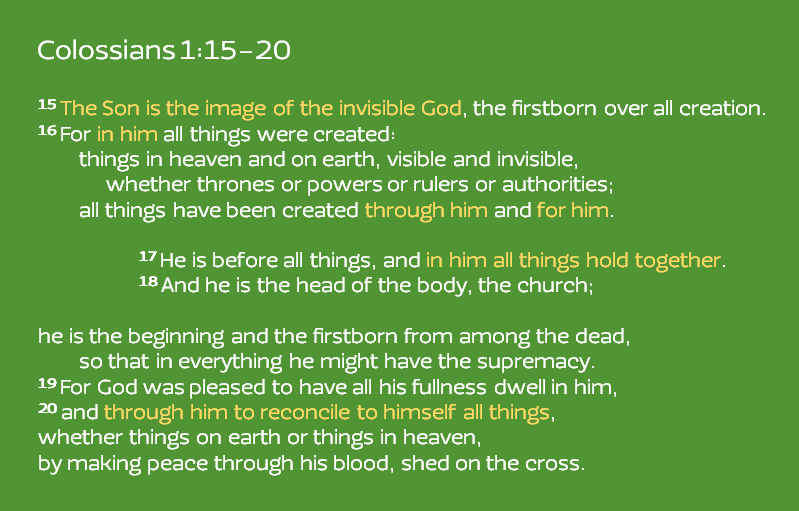
While the Genesis accounts depict the first human as the imago Dei, here in this Pauline letter Christ is indeed the perfect and ultimate image of God. Meanwhile, all things in heaven and on earth, visible and invisible, are created through Him, by Him and for Him (v.15-16). He is also the One through Whom all things are reconciled (v.20). Between these two profound truths depicted with the chiastic device of the poem in the first and last verses, identifying Christ as the Creator and Saviour of all things, there comes in the middle the focus of Christ being the Sustainer of all things, “holding all things together” (v.17), both the created and redeemed ones. The same assertions are found in Hebrew 1:3 as well, where it reads, “The Son is the radiance of God’s glory and the exact representation [that is, image] of his being, sustaining all things by his powerful word.” (NIV)
Another Christological poem, Philippines 2:5-11, continues the same affirmation of Christ’s divine identity and works, but now brings the Incarnation of Christ to the forefront. Christ, “being in very nature God, did not consider equality with God … [for] his own advantage; rather, he made himself nothing by taking the very nature of a servant, being made in human likeness.” (v.6-7, NIV) The Incarnation of Christ has profoundly reinterpreted the imago Dei, shifting it from the original and ordinary human identity to locating its perfect, archetypal fulfillment in Jesus Christ, who is the “true Image.” Humanity is thus able to be restored and transformed toward that “true Image” through union with Christ, as He embodies God’s character and restores divine-human relationship. In the Incarnation, God the Son empties himself and takes on the form of a servant and becomes human, not by relinquishing his divine nature, but by voluntarily setting aside the divine privileges to live as a simple and limited human being, demonstrating ultimate humility. This divine self-emptying, relinquishing privileges, identifying with the others, humble servant-hood, even to the “extreme” of sacrificing himself, provide us with the crucial theological and practical pointers to the key postures and approaches of how Christian mission in the world should look like. On that note we turn to the Gospel of John, in which we see other important dimensions of the Incarnational directive of Christian mission.
Here in John’s Gospel we encounter another chiastic structure typical of the Scripture, though in a much larger scale, covering the entire Gospel (Hamilton 2025, 28).
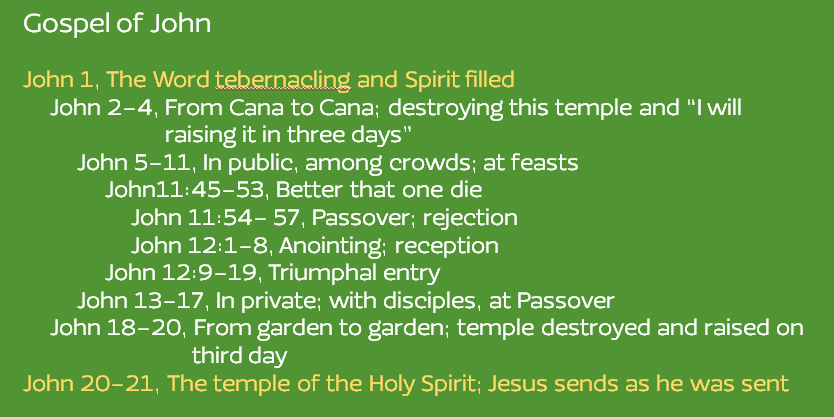
At the very beginning of that Gospel:
“In the beginning was the Word, and the Word was with God, and the Word was God. … The Word became flesh and made his dwelling among us. We have seen his glory, the glory of the one and only Son, who came from the Father, full of grace and truth,“ (John 1:1, 14, NIV)
John the Apostle was essentially proclaiming that the Sovereign Lord God had returned as promised, pitching his tent among his people, showing forth everywhere his glory, which actually means his all-encompassing presence. As the glorious presence of the Lord God was manifested in the person of Jesus throughout the Gospel, the visions of Shalom were invoked once again – turning water into wine, feeding the hungry, healing the sick, restoring the outcast, liberating the possessed, even raising the dead.
Leaping forward to the corresponding final unit of John’s Gospel, this same Word, now the resurrected Lord Jesus, appeared in front of his fearful but anticipating disciples, and told them:
“Shalom be with you! As the Father has sent me, so I am sending you.” And with that he breathed on them and said, “Receive the Holy Spirit. If you forgive anyone’s sins, their sins are forgiven; if you do not forgive them, they are not forgiven.” (John 20:21-23, NIV)
With the echo of John 1:14 looming large, we can see that Jesus was essentially saying: “I am sending you all now in the similar fashion as God the Father has sent me.” Jesus the Word was sent to dwell among us in the world, “pitching his tent in our neighbourhoods.” (The Message) And that is the glorious presence of the Son with us, full of grace and truth.
Now Jesus commissioned his followers, essentially and subsequently meaning all Christians, to be his faithful presence in the world with grace and truth, in the similar way as God sent his only beloved Son pitching the tent among his people once again. And they were “installed” into this commission, with a perplexed gesture of “breathing on” the disciples by the resurrected Jesus. Again this invokes yet another powerful echo, this time from Genesis 2 – the Lord God installing His priestly representative in His cosmic Temple – now not just one adam but many of the descendants.
This Incarnation-oriented commission of Christ’s disciples has the “forgiving of sin” as the main given task. In the biblical traditions, this is in fact the shorthand of the roles and functions of priestly judges, whose main task is not passing verdicts or condemnations but, instead, making and declaring relationships in the right, as N.T. Wright puts it categorically (Wright 2026, at the 15th minute). This is corresponding to Christ’s ultimate work – reconciling all things to Himself, as narrated in the Colossians poem we went through earlier. Now that the disciples were commissioned to participate in that work, being the faithful presence, essentially the witness-in-action, of Christ’s work of making all things right in their relationships to each other, including humanity with God, among humans, and humanity with the rest of the creation, in other words, leading toward the biblical vision of Sabbath-Shalom (Brueggemann 1978; Yoder 1997; Timmer 2017).
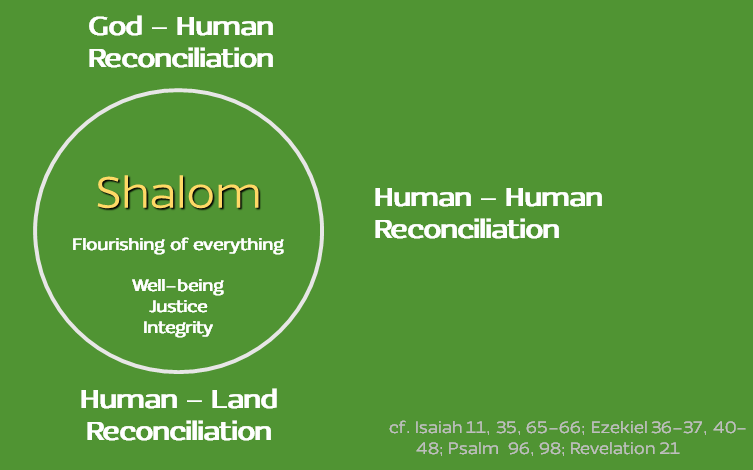
Furthermore, both the sending of Jesus by the Father and the sending of the disciples by Jesus involve the Holy Spirit, who is present all through God’s works in creation, right at the very beginning of the cosmos, in the forming of the first humans as imago Dei, in the Word becoming flesh, in the commissioning of the renewed and transformed imago Dei in Christ, and in the continuous empowering presence among God’s people in the world. This completes the magnificent picture of Missio Trinitas (Park 2025), that is, the triune God – Father, Son, and Holy Spirit, working in tandem to create, sustain, redeem, and renew not just humanity but all of creation, in which the redeemed humanity is also involved and commissioned to play a pivotal part.
The Missional Presence of Transformed imago Dei in midst of the threefold ecological crisis
I hope by now this is obvious to you that the paradigm of transformed imago Dei in creation is way more colourful, engaging, bold, and wide in scope. It is manifested in the missional presence of God’s people in the world, that is, witness-in-action for Christ’s reconciling and renewing of all things, Incarnation-oriented and Spirit-filled. It is far more than stewardship.
When we follow the model of Christ’s Incarnation in the Holy Spirit as the sent people, how all these characteristic features of the Incarnation – identifying with, dwelling among, emptying and humbling oneself, servanthood, sacrifice, even dying for “others,” would entail in our missional call in midst of the suffering and despair caused by the threefold ecological crisis? What would this grace-and-truth-filled faithful presence look like in our world today then? How would this presence impact the core Christian mission of reconciliation and shalom-making?
Perhaps, the answer lies in us, the transformed imago Dei, being the faithful witness-in-action of God’s on-going restoring and redemptive acts in the suffering and groaning creation, even in midst of seemingly hopeless circumstances. In the words of Paul the Apostle, “For the creation waits in eager expectation for the children of God to be revealed” (Romans 8:19, NIV).
I imagine that the missional presence, or witness-in-action, would be in praying, weeping and lamenting with those who are suffering and in devastation because of the ecological calamities. Perhaps in the resistance against the powerful forces or even in the prisons because of non-violent civil disobedience actions. Perhaps among those ancestral land defenders, many of whom are also followers of Christ, putting their safety and even lives on the line. After all, in the Incarnation of Christ, “Suffering and dying is the way by which the world is changed” (Wright 2016, 368).
And perhaps among more mundane contexts, such as on pulpits or in classrooms teaching old and young about the meanings and implications of Christ reconciling all things; in reducing our consumption of “stuffs” for the sake of others – wildlife and people alike; in local community gardens advocating for food security and climate resilience; in climate marches advocating for drastic changes; on campaign trails for environmentally-conscious politicians or even running public offices for the ecological reasons; in corporate boardrooms discerning decarbonized or nature-investing finance; in engineering labs testing new energy saving technology; in community projects restoring wetlands or strengthening forests, in planting native trees or removing invasive species; in welcoming, receiving and hosting refugee families who have to flee from their countries because of ecological collapse; in the public arenas or international forums speaking Truth to powers on behalf of those vulnerable, humans and nonhuman; in the financial advisor’s office, bridging and advocating for the wellbeing of both the investors and the communities and habitats being impacted by the investment portfolio in concern.
And whatever sphere or situation we might find ourselves in!
And perhaps simply, as Debra Rienstra puts it eloquently, starting with naming, knowing, delighting, caring, suffering (Rienstra 2019, chap. 8), as the beginning steps to become the faithful presence – witness-in-action – of the reconciliation and renewal of all of creation, promised by the Christ who creates, sustains, and reconciles all things, and is already on the move.
Lord Jesus,
Help us to be your presence, full of grace and truth, in this world of calamities and sufferings. Help us to discern where that presence should be. Grant us the strength and courage to embrace these possibilities. Be with us when we go alone. Guide us to like-minded communities from where your presence could be manifested together. Encourage us when we are discouraged or disheartened. Speak to us or through us when you see appropriate. Lord be with us, so that we can be your presence in your world.
Amen!
Reference:
Bauckham, Richard. 2010. The Bible and Ecology: Rediscovering the Community of Creation. Waco: Baylor University Press.
Beale, G.K. 2004. The Temple and the Church’s Mission: A Biblical Theology of the Dwelling Place of God. Downers Grove: InterVarsity Press.
Blocher, Henri. 1984. In the Beginning: The Opening Chapters of Genesis. Leicester, UK: Inter-Varsity Press.
Brueggemann, Walter. 1978. Living Toward A Vision: Biblical Reflections on Shalom. United Church of Christ Press.
Foran, Clare and National Journal. 2015. “Scientists Link Climate Change to Syrian War: New research argues that global warming added to problems that caused Syria’s civil war.” The Atlantic. March 2, 2015. https://www.theatlantic.com/politics/archive/2015/03/scientists-link-climate-change-to-syrian-war/443820/
Fransen, Taryan. 2025. “1.5 Degrees C: Understanding World’s Critical Warming Threshold.” World Resources Institute. January 18, 2025. https://www.wri.org/insights/1-5-degrees-c-target-explained
Groenendyk, Kathi. 2019. “Words Matter, but Audience Matters More.” In Beyond Stewardship: New Approaches to Creation Care, edited by David Paul Warners and Mathew Kuperus Heun, 31-40. Grand Rapids: Calvin College Press.
Hall, Douglas John. 1985. Imaging God: Dominion as Stewardship. Grand Rapids: Eerdmans.
Hamilton, James H. Jr. 2025. In the Beginning Was The Word: Finding Meaning in the Literary Structure of the Gospel of John. Grand Rapids: BakerBooks.
Middleton, J. Richard. 2005. The Liberating Image: The Imago Dei in Genesis 1. Grand Rapid: Brazos Press.
–. 2014. A New Heaven and a New Earth: Reclaiming Biblical Eschatology. Grand Rapids: Baker Academic.
Park, Bokyoung. 2025. “Resonance as Mission: Reimagining Missio Trinitas in the Era of World Christianity.” 2025 Missiology Lectures. Fuller Seminary. October 15, 2025. https://fullerstudio.fuller.edu/video/resonance-as-mission/
Provan, Iain. 2006. The Book of Genesis. Regent College Lecture Recording. Regent Audio, 2006 – http://www.regentaudio.com/RGDL3603S?category_id=32.
Rienstra, Debra. 2019. “What’s That? Naming, Knowing, Delighting, Caring, Suffering.” In Beyond Stewardship: New Approaches to Creation Care, edited by David Paul Warners and Mathew Kuperus Heun, 107-120. Grand Rapids: Calvin College Press.
Timmer, Kevin J. 2017. Shalom Seeking: Foundations of Flourishing. Cedarville University.
Walsh, Brian J. & Sylvia C. Keesmaat. 2004. Colossians Remixed: Subverting the Empire. Downers Grove: InterVarsity Press.
Walton, John H. 2006. Ancient Near Eastern Thought and the Old Testament: Introducing the Conceptual World of the Hebrew Bible. Grand Rapids: Baker Academic.
–. 2009. The Lost World Of Genesis: Ancient Cosmology and the Origins Debate. Downers Grove: IVP Academic.
Warners, David Paul & Mathew Kuperus Heun. 2019. “Introduction.” In Beyond Stewardship: New Approaches to Creation Care, edited by David Paul Warners and Mathew Kuperus Heun, 5-20. Grand Rapids: Calvin College Press.
White, Lynn Jr. 1967. “The Historical Roots of our Ecologic Crisis”. Science 155 (3767): 1203-1207. http://www.sciencemag.org/content/155/3767/1203.citation.
World Wildlife Fund. 2024. “The Living Planet Report.” https://livingplanet.panda.org/.
Wright, N.T. 2002. Paul for Everyone: The Prison Letters. London: Society of for Promoting Christian Knowledge.
–. 2016. The Day The Revolution Began: Reconsidering the Meaning of Jesus’ Crucifixion. San Francisco: HarperOne.
–. 2026. “God’s Homecoming: The Biblical Story We Were Never Taught.” The Center for Bible Study, February 25 2026. https://youtu.be/AnLQLpy2MOA?si=sO8gUub0ji8FduVB.
Yoder, Perry B. 1997. Shalom: The Bible’s Word for Salvation, Justice, & Peace. Institute of Mennonite Studies.
 An Earthkeeper's Notebook